黑白之痕——彭玮雯的工业家庭叙事与行为创作回顾2024(一)
2024年,"对角线计划Diagonal"正式与公众见面,我们在这一年里组织策划了各种类型的活动,展览,考察,对谈,从今天开始这里将陆续推出“对角线计划2024回望系列”,我们会陆续推出文章总结记录这一年所做的重要项目,用不同形式的文本与大家继续分享和讨论有关问题和现象,部分文本采用中英双语,以供交流。
今天的文章是“对角线计划”联合发起人彭玮雯关于“黑白系列”的创作回顾第一篇。
“黑与白”(煤与盐)的创作脉络与最新艺术项目
创意理念
碳和盐,一个来自我父亲,一个来自我母亲,他们都在碳和盐厂工作。这两个元素与我和我的家人都息息相关 。就像《八卦》中黑白之间的平衡和相互作用一样,它们与我对过去和未来的记忆以及身体与自然之间的持续联系有关。这两种材料已经埋在地下数百万年,也铭刻在时间中。
它们不仅代表着工业生产的残余物,还承载着个人和集体记忆的重量。通过使用碳和盐作为主要材料,我回应了个人和家族历史与工业遗产之间的深刻联系。该系列作品通过现场表演和公共装置探索这些元素如何与特定场所的历史和环境产生共鸣。
该项目中使用的碳和盐不仅仅是创意材料,它们还象征着个人历史、工业遗产和自然力量之间的复杂关系。这些材料通过特定地点的变形和消失,与时间的流逝和物质的变形相呼应,验证了人类与自然、过去与未来的深厚联系。
黑色系列
煤之痕·流动
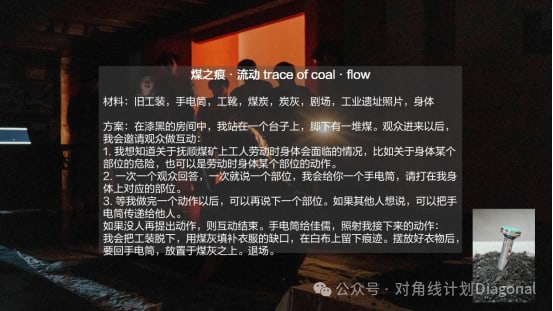
材料:旧工装,手电筒,工靴,煤炭,炭灰,剧场,工业遗址照片,身体
行为现场,2024
展览信息
《同时代东北——工业文化保育概念展》之《空间先锋——工厂,城市与青年》特别呈现
展览地点:铁锚1956文化创意产业园,中国辽宁省沈阳市
展览时间:2024年9月22日——10月31日
行为现场时间:2024年9月22日(周日)13:00—15:30
创作概念
在东北有许多没落的工业老城,它们沉默地诉说着过去的辉煌与如今的衰败。抚顺,曾经是经济发达的煤矿城市,如今随着工业改革而陷入停滞。这里独特的煤矿社区与工业废墟美学,成为我黑与白(煤与盐)系列创作的起点。作为一个外来者,我第一次踏入这样一个完全陌生的环境,试图通过作品熟悉并理解本地的工业历史与人文特质。
我设置了一场与本地人互动的行为艺术创作,让亲历者口述并描绘矿工劳动的身体经验,而我则将这些叙述转化为抽象的行为动作。互动规则(由观众决定身体部位与动作)将单向叙事转变为共创叙事,使作品不再是单纯的历史表达,而是关于记忆与身体的对话。一方面,我尝试以视觉化的方式与当地人建立联系,打开一扇对话的窗口。另一方面,我希望通过这次创作激发人们对矿工群体的劳动的关注,并出发思考煤矿行业背后深厚历史和社会意义;通过这件作品,我初步接触并感知了这一地区关于矿难的惨痛历史,劳动者身心双重的苦难,以及东北人乐观坚韧的生命态度。这片土地上赖以生存的煤矿,承载了无数家庭的悲欢离合,也启发我去进一步思考这种材料与历史、大地、生命之间的深刻联系……
空间与材料布局
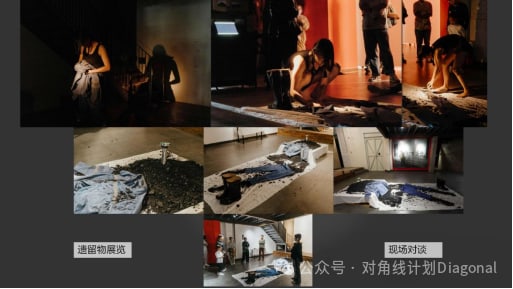
这件作品以煤炭、煤灰、旧工装、工靴等材料与展厅的剧场空间形成了多层次的互动。
此次行为艺术作品《煤之痕·流动》通过煤炭、煤灰等材料与特定展览空间的融合,形成了对东北工业历史的叙事性表达,同时呈现观众与表演者间的对话。这种互动设计和材料布局构成了项目的核心:
中央:台子与煤堆(作品核心)。
黑暗环境:黑暗环境增强沉浸感,暗示矿井幽闭的环境。黑暗展厅提供了“矿井化”的沉浸环境,光束与黑暗的交互展现了身体与空间的“可见”与“不可见”,使想象与现实之间的距离变得触手可及。
煤炭与煤灰:来自抚顺矿场的煤矿和煤灰象征当地工业的遗产与衰退,通过涂抹和填补的动作转化为视觉化的“痕迹”,身体作为媒介直接体现工业材料与劳动动作之间的关系。煤炭与煤灰的物质形态传递工业的重量,同时其易碎性和扩散性暗喻记忆的脆弱与消散。
手电筒:光线作为互动媒介,聚焦身体的互动点,凸显局部细节。将观众的参与融入创作,通过光束与身体的结合,连接观众与叙事。而手电筒的光是现场唯一的光源,暗示在黑暗中存在的希望。
旧工装与工靴:作为曾经劳动者的具象符号,在表演中逐渐失去功能性,转变为抽象的身份符号。工装与煤灰的结合是一种反功能性的重构,既彰显了劳动遗迹,又凸显了当下的失落感。
白布:白布限制并聚焦了行为范围,使其作为完整的“舞台”,也是后续装置作品的“展台”。象征性地承载身体动作的痕迹,成为情感与记忆的延续。也是一块画布——我用煤炭填满了工装之间的缝隙,留下肢体存在的痕迹,以此暗示和缅怀逝去的生灵。煤灰填补工装的动作,则进一步强化了破碎与修复的二元对立,呼应了工业衰退与人类记忆的不可挽回。
材料与空间的结合直接反映了抚顺煤矿的工业历史、工人身体的伤痕与记忆的遗存。黑暗空间与煤的存在共同营造了压迫感,观众通过手电筒的焦点窥见“隐秘的伤痛”,实现对矿工身体体验的共鸣与想象。材料的每一步转化都讲述了劳动与工业的牺牲故事。
表演过程
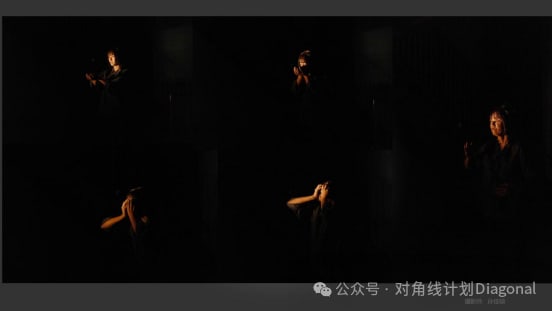
在漆黑的房间中,我站在一个台子上,脚下有一堆煤。
观众进来以后,我会邀请观众做互动:
1. 我想知道关于抚顺煤矿上工人劳动时身体会面临的情况,比如关于身体某个部位的危险,也可以是劳动时身体某个部位的动作。
2. 一次一个观众回答,一次就说一个部位,我会给你一个手电筒,请打在我身体上对应的部位。
3. 等我做完一个动作以后,可以再说下一个部位。如果其他人想说,可以把手电筒传递给他人。如果没人再提出动作,则互动结束。
手电筒给佳儒,照射我接下来的动作:我会把工装脱下,用煤灰填补衣服的缺口,在白布上留下痕迹。
摆放好衣物后,要回手电筒,放置于煤灰之上。
退场。
身体动作的表达与参与
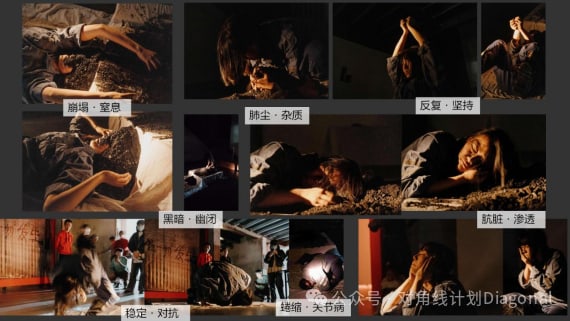
通过观众提出的身体部位与动作,我将这些描述转化为七个动作部分,分别对应煤矿工人劳动中真实的身体经验与潜在风险:
1.开采导致崩塌与掩埋:再现矿井不稳定造成的危险场景,身体在坍塌的动态中表现挣扎与无助。
2.窒息风险:因矿洞缺氧或天然气泄露而产生的窒息感,用动作呈现呼吸受限的痛苦。
3.职业病——尘肺病:通过持续性的胸腔运动模拟长期吸入煤灰杂质对呼吸道的侵害。
4.幽闭环境的身心压抑与视力受损:表现黑暗与狭窄空间对心理与身体的双重负荷。
5.重复性劳作的身体磨损:再现单调劳动导致的关节损伤与风湿病症,动作僵硬而沉重。
6.繁重劳动的对抗性:体现工人以身体对抗自然力量的艰难,同时传递出力量与稳定的矛盾。
7.从头到脚被煤灰覆盖的“黑化”身体:通过身体动作表现煤灰对皮肤的反复涂黑侵蚀,回应“小黑人”的称呼带来的象征性隐喻。
参与式艺术的互动设计
可见与不可见——光线与身体
黑暗展厅与唯一的光源(手电筒)构建了压迫感,同时赋予观众掌控光线的权利,形成了身体与空间“可见”与“不可见”的动态关系。
手电筒由观众掌控,其移动方式构成了“身体地图”,这意味着观众主观的光束轨迹塑造了空间中的视觉焦点,也意外使煤堆与白布之间的关系得以突出。也体现了主客体之间观看的关系。互动规则展现了艺术家对观众参与的重要性,未来可以扩展至更长时间的表演,或引入多种媒介互动(声音、视频)。
视觉和触觉——流动的观看
煤炭和煤灰不仅作为象征工业遗产的媒介,更在表演过程中以涂抹、填充的方式与空间和身体交融,暗示工业劳动的伤痕以及记忆的无形流动。当煤炭暴露于聚焦手电光束下时,其纹理与灰尘的反光显现出强烈的视觉冲突,意外地增强了煤炭本身的物质性。观众不仅感受到材料的沉重,也感知到其“微尘”状态的无形扩散。观众的光束掌控在空间中塑造视觉焦点,体现了主客体观看方式的流动性。这种互动设计突出了创作者对共创叙事的探索,也为未来加入多媒体互动提供了可能性。
真实与想象的隐喻——语言与行动
每个观众的指令不仅改变了我表演的行为轨迹,也在观看和等待互动的间隙中,促使观众思考与回忆与煤矿劳动相关的历史与经验。在即兴创作中,表面上我的动作基于观众对煤矿工人体力劳动危险性的真实描述,实际上却承载了作为创作者对未知劳动情景的想象与现场反馈。这种从语言到动作的抽象转化,是一种难以形容的“模糊地带”。动作的即兴性让观众直接感受到艺术家作为矿工形象的代表呈现“痛苦”,而这痛苦并非真实,而是对矿工身体劳动消耗的隐喻。
观看与思考的共生关系
观众在指令与等待中不仅观察表演,也思考煤矿工人体力劳动背后的历史、风险与牺牲。通过聚焦于动作的“痛苦”隐喻,作品激发了观众对工业历史的情感联想。通过这一表演,我试图引导观众在参与中深入思考工业历史中,工人体魄遭受规训和消耗的深刻命运,以及隐藏在每个动作背后的沉重故事。在表演结束后的交流环节,观众们谈论到他们自己的感受金额思考也应征了我的设想。一位孩子的母亲被感动到哭泣,我们都认同现场参与艺术是能给下一代带来很好启发和思考的教育路径。
意想不到的见解或发现
在创作这个作品之前,我并没有对抚顺当地有过多的了解和深入思考,因此整个过程对我来说是一场全新的尝试,同时也是一次巨大的挑战。在开始创作之前,我并不了解当地人对这一主题的思考和可能的反应。然而,当作品完成并进入现场展示后,我与观众在对谈环节中的交流让我有非常意外的收获。
观众的情感共鸣超出预期 首先,我有这个创作方案的时候就知道会对当地人造成视觉和心理冲击(甚至是造成不适)。但让我感到欣慰的是,他们以开放和欢迎的态度接纳了我的尝试。对于许多当地观众来说,这是他们第一次观看行为艺术表演。尽管他们对这种艺术媒介的了解非常有限,但我通过表演试图传达劳动带来的身体与精神创伤,这种强烈的情感表达使他们能够深切共情我的表演。许多观众在观看过程中感受到深深的悲伤和心疼,他们的反应十分真挚而强烈。甚至有人表示因为共情我的痛苦而希望我停止表演,这种情感投入大大超出了我的预期。当听到观众表达出这样的心理感受时,我感到既欣慰又感激,因为这意味着我成功传递了想要表达的情感和主题。证明了艺术跨越文化和媒介的共通性。
本地创作者对这一叙事主题的回避 此外,与我本次创作的摄影师兼独立影像导演的交流也给了我深刻的启发。他惊讶于我敢于触碰如此悲痛的主题。他提到,抚顺本地艺术创作者们往往不愿直面与煤矿工人相关的伤痛和死亡等主题。这并非因为他们对这一现实漠不关心,而是因为这些叙事与他们自身的经历密不可分。每个人都或多或少地与煤矿的叙事息息相关。谈及矿工的苦难,尤其是关于死亡、亲人离世和家庭分离等主题,对于他们而言往往是艰难且痛苦的,他们很难以轻松的心态通过艺术呈现这些内容。这种心理上的回避让我反思,作为一个“局外人”,我能够以相对冷静和“轻松”的视角介入并呈现这些苦难,这种距离感反而成为创作的独特优势。这也让我对于跨地域跨文化研究和创作有了新的思考:是否每个艺术家都能提供不同的视野和角度呢?这种本地艺术家和外地艺术家的创作交流非常有价值。
突破心理障碍和材料尝试 和观众们的对话工业叙事创作及其所承载的私人情感有了更深的思考。我的父亲同样是一位电碳工人,但过去我始终回避使用煤矿材料进行创作。因为这直接与他繁重的工作劳动和生命相关。通过这次创作和对话,我发现人们对至亲的爱与关怀反而阻碍了大家面对他们的痛苦与处境。这一感悟不仅让我重新审视材料的选择,这次创作过程中,我深刻感受到材料本身所承载的文化和情感力量。过去,除了家庭叙事研究对象不同的原因。我更多使用盐这一干净、纯净的材料,而煤矿这种“肮脏”的材料却意外地让我深入思考劳动的痛苦与社会的无形伤痕。这种材料选择的转变不仅是技术层面的尝试,更是观念上的突破,提示我应在未来创作中更多关注材料与情感的共鸣。
艺术作为情感与文化之间的桥梁 许多第一次接触行为艺术的观众在观看过程中不仅理解了这一艺术形式,还通过共情增强了对劳动主题的认识。这让我惊讶于艺术在促进情感连接和文化交流中的潜力,尤其是在文化资源有限的地方,它能成为激发公众对社会议题关注的重要媒介。艺术是一座桥梁,它让我们能够表达情感并传递力量。我希望自己的艺术创作能为这些劳动者带来某种程度的疗愈与精神慰藉。这不仅是为他们,也是为所有大众,以及对我的家人、对整个世界人类群体和大地的一种回应。这次创作教会了我对一切事物和生命心怀敬畏,也让我懂得了尊重与关怀的意义。这或许是我更深入理解人与世界关系的一个重要起点。也让我意识到,艺术创作可以成为面对内心深处复杂情感的途径。此次创作是我一次勇敢的尝试,让我更冷静地思考,如何以更真实的方式去关心和关注人们的生活状态及心理情绪。
对未来创作和研究的影响
推动“材料性”研究与叙事延展
煤炭与煤灰的使用为我表达工业历史开辟了新的可能性。未来可尝试将盐或其他象征性工业材料融入创作,探索不同质地和形式的叙事潜力。并且。项目中煤炭和煤灰作为材料所承载的社会隐喻,为后续发展和延续自己独特的创作语言与研究方法提供了灵感。
记忆景观的构建
结合东北特定工业遗址的真实场景(如废弃矿井)进行表演,或采用更复杂的空间构造(如多层次投影),将材料性与空间性深化为“记忆景观”。在未来项目中,可尝试通过地形装置模拟矿山废墟,结合材料行为呈现“劳动与时间”的视觉叙事。通过将身体痕迹融入“地貌”,强调工业衰退与生态记忆的不可分割性。
观众互动方式的拓展
提供多种互动媒介(如煤炭制成的纸张供观众书写),深化语言与动作的双向转化。
引入声音、视频或虚拟影像,与身体表演相结合,丰富材料与叙事间的互动维度。例如,以矿工的声音记录为背景音,或通过投影呈现矿难场景的历史画面。
社区参与艺术创作方法 本项目中通过观众参与生成身体动作的实验模式,揭示了社会参与艺术如何激发对工业文化的记忆与反思。这一经验可以作为博士课题中社会参与实践的典型案例,并激发在西南社区中开展类似互动艺术实验的可能性。
彭玮雯
Vivienne Peng
普利茅斯大学当代艺术在读博士生,四川美术学院实验艺术专业硕士, “对角线计划Diagonal”联合发起人。四川自贡盐厂与三线电碳厂的工人后代。
实验艺术家,现目前运用行为,装置,影像与新媒体等跨媒介语言进行在地性艺术创作。主要创作材料为盐、煤炭、炭黑与工业废弃材料。博士课题研究从东北到西南的后国营工业社区的社会介入性艺术。关注中国建国时期的东北工业到三线建设时期的西南之后的当代工业叙事,探索个体生命溯源与地方性社群文化的生态与关联。流动居住于英国,欧洲与中国。
In 2024, the "The Diagonal" will officially meet the public, and we have organized and planned various types of activities, exhibitions, inspections, and dialogues in this year, and from today onwards, we will launch the "The Diagonal 2024 Retrospective Series", we will continue to launch articles summarizing and recording the important projects done this year, and continue to share and discuss relevant issues and phenomena with you in different forms of texts, some of which are bilingual in Chinese and English for communication.
Today's article is the first review of the creation of the "Black and White Series" by Peng Weiwen, the co-founder of the "Diagonal ".
Creation Context of "Black and White" (Coal and Salt) and the Latest Art Project
Creative Concept
Carbon and salt, one from my father and one from my mother, who both worked in the carbon and salt factories. These two elements are deeply connected to both me and my family. Like the balance and interplay between black and white in the Eight Diagrams, they are linked to my memories of the past and future, as well as the constant connection between the physical body and nature. These two materials, which have been buried underground for millions of years, also inscribe time.
They not only represent remnants of industrial production but also carry the weight of personal and collective memories. By using carbon and salt as primary materials, I respond to the deep connection between personal and family history and industrial heritage. This series of works explores how these elements resonate with the history and environment of specific places through live performances and public installations.
The carbon and salt used in the project are not just creative materials; they also symbolise the complex relationship between personal history, industrial heritage, and natural forces. Through transformation and disappearance at specific sites, these materials echo the passage of time and the transformation of matter, validating the deep connection between humans and nature, the past and the future.
Black Series
Trace of Coal·Flow
Materials: Old work uniforms, torches, work boots, coal, ash, theatre, industrial site photographs, live performance
Exhibition Information:《Contemporaneous Northeast - Industrial Culture Preservation Concept Exhibition》,《Space Pioneer: Factory, City and Youth》Specially Presetation
Exhibition Venue: Iron Anchor 1956 Cultural and Creative Industry Park, Shenyang, Liaoning Province, China
Exhibition Times: 2024.9.22——10.31
Behavior Field Time:2024.9.22(Sunday)13:00—15:30
Creative Concept
In Northeast China, many decaying industrial cities silently speak of past glory and current decline. Fushun, once a prosperous coal mining city, now faces stagnation with industrial reform. The unique coal mining community and the aesthetic of industrial ruins became the starting point for my "Black and White" (Coal and Salt) series. As an outsider, I first stepped into this unfamiliar environment, trying to familiarise myself and understand the local industrial history and cultural traits through my work.
I created a performance art piece that involved local residents, where they narrated and illustrated the physical experiences of miners, and I transformed these narratives into abstract actions. The interaction rule (decided by the audience, selecting body parts and movements) turned a one-way narrative into a co-creative narrative, making the work not just a historical expression but a dialogue about memory and the body. On one hand, I tried to connect with the locals visually, opening a window for dialogue. On the other hand, I aimed to raise awareness of the miners' labour and provoke thoughts about the profound historical and social significance behind the coal mining industry.
Through this work, I began to perceive the painful history of mining accidents in this area, the dual suffering of workers’ bodies and minds, and the resilient life attitude of the Northeast people. The coal mines that sustain life in this land carry the joys and sorrows of countless families, inspiring me to reflect further on the profound connection between these materials, history, the earth, and life.
Space and Material Layout
This work interacts on multiple levels with materials such as coal, ash, old work uniforms, and work boots within the theatrical space of the exhibition.
The performance art piece Trace of Coal·Flow uses materials like coal and ash to fuse with the specific exhibition space, providing a narrative expression of Northeast China's industrial history, while also presenting a dialogue between the audience and the performer. The interaction design and material layout form the core of the project:
·Centre: Platform with coal pile (core of the work).
·Dark Environment: The dark setting enhances immersion, hinting at the confined environment of the mine. The dark exhibition hall provides a "mining" immersive environment, where the interaction of light and dark reveals the "visible" and "invisible" of the body and space, making the distance between imagination and reality tangible.
·Coal and Ash: Coal and ash from Fushun's mines symbolise the legacy and decline of local industry, turning into "marks" through actions of smearing and filling, with the body serving as a medium to directly express the relationship between industrial materials and labour actions. The fragile and dispersive nature of coal and ash metaphorically suggests the fragility and disappearance of memory.
·Torch: Light is used as an interactive medium, focusing on points of interaction between the body and the audience. It is the only light source in the space, symbolising hope in darkness.
·Old Work Uniforms and Boots: As concrete symbols of former workers, they gradually lose their functionality in the performance and transform into abstract symbols of identity. The combination of uniforms and coal ash becomes a de-functional reconstruction, highlighting both the legacy of labour and the sense of loss in the present.
·White Cloth: The white cloth restricts and focuses the range of the actions, becoming a complete "stage" and also a "display platform" for future installation works. Symbolically, it carries the traces of body movements, continuing the emotions and memories. It also serves as a canvas—where I filled the gaps between the uniforms with coal, leaving traces of the body’s presence, suggesting and commemorating the lost lives. The action of filling the uniforms with ash further strengthens the binary opposition of breaking and repairing, echoing the irretrievable nature of industrial decline and human memory.
The combination of materials and space directly reflects the industrial history of Fushun's coal mines, the scars of workers' bodies, and the remnants of memory. The dark space and the presence of coal create a sense of oppression, and the audience uses the torch to glimpse the "hidden wounds," resonating with the body experiences of miners. Each step of material transformation tells the story of sacrifice in labour and industry.
Performance Process
In the dark room, I stand on a platform with a pile of coal beneath my feet. After the audience enters, I invite them to participate:
1.I would like to know about the physical risks miners face in Fushun’s coal mines, such as the danger to a specific body part or the movement of the body during labour.
2.One audience member answers at a time, describing one body part, and I will give them a torch to focus on that part of my body.
3.Once I complete an action, another part of the body can be suggested. If someone else wants to suggest, they may pass the torch. The interaction ends when no further actions are suggested. The torch is handed to Jiaru, who shines it on the next movement: I will take off the work uniform, filling the gaps with coal ash, leaving traces on the white cloth. Once the uniform is arranged, I will return the torch and place it on the ash, then exit.
Body Movement Expression and Participation
Through body parts and actions suggested by the audience, I transformed these descriptions into seven movement segments, corresponding to the real physical experiences and potential risks of coal miners:
1.Cave-in and burial caused by mining instability: Recreating the dangerous scene caused by unstable mines, the body expresses struggle and helplessness in the collapse dynamic.
2.Asphyxiation risk: Depicting the suffocating feeling caused by lack of oxygen or gas leaks in mines, presenting the pain of restricted breathing.
3.Occupational disease—pneumoconiosis: Simulating long-term inhalation of coal dust and debris that harms the respiratory system through continuous chest movement.
4.Mental and physical oppression in confined spaces and vision impairment: Depicting the dual pressure of dark, narrow spaces on the mind and body.
5.Physical wear from repetitive work: Recreating joint damage and rheumatism caused by monotonous labour, with stiff and heavy movements.
6.The confrontation of heavy labour: Expressing the difficulty of workers resisting natural forces with their bodies, while conveying the contradiction of strength and stability.
7.The "blackened" body covered in coal ash: Depicting the repeated smearing of coal ash on the skin, responding to the symbolic metaphor of the term "little black man."
Interactive Design of Participatory Art
Visible and Invisible—Light and the Body: The dark exhibition hall and the torch as the only light source create a sense of oppression, while giving the audience the power to control the light, forming a dynamic relationship of "visible" and "invisible" between the body and space. The movement of the torch controlled by the audience creates a "body map", meaning the audience's subjective beam trajectory shapes the visual focus in space, highlighting the relationship between the coal pile and the white cloth. This also reflects the relationship between the observer and the observed. The interaction rules demonstrate the importance of audience participation, and the performance could be extended or involve more multimedia interactions in the future.
Vision and Touch—Flowing Observation: Coal and ash not only serve as media symbolising industrial heritage, but also blend with space and the body through the act of smearing and filling, suggesting the scars of industrial labour and the invisible flow of memory. When coal is exposed under the focused beam of the torch, its texture and dust reflections reveal a strong visual contrast, unexpectedly enhancing the materiality of the coal. The audience feels not only the weight of the material but also its "dusty" state of invisible diffusion. The control of the light beam by the audience in space shapes the visual focal point, demonstrating the fluidity of the observer-observed relationship. This interactive design highlights the artist’s exploration of co-creation narrative and opens possibilities for future multimedia interactions.
Visual and Tactile – Fluid Watching Coal and coal ash serve not only as mediums symbolising industrial heritage but also blend with space and the body through actions of smearing and filling during the performance, suggesting the scars of industrial labour and the intangible flow of memory. When coal is exposed under the focused beam of a flashlight, its texture and the reflective dust create a strong visual contrast, unexpectedly enhancing the materiality of the coal itself. The audience experiences the weight of the material while also sensing its “fine dust” state, which spreads invisibly. The beam controlled by the audience shapes visual focal points in space, reflecting the fluid nature of subject-object viewing. This interactive design highlights the creator's exploration of co-creation narratives and also opens possibilities for multimedia interactions in the future.
Metaphors of Reality and Imagination – Language and Action Each audience member's instructions not only alter the trajectory of my actions but also, in the interlude of observation and waiting, prompt them to think and recall the history and experiences associated with coal mine labour. In improvisation, my actions are superficially based on the audience's real descriptions of the physical dangers faced by coal miners, but they also carry the creator's imagination and live feedback of unknown labour scenarios. This abstract transformation from language to action forms an indescribable “grey area.” The spontaneity of the actions allows the audience to directly experience the “pain” presented through the artist’s representation of a miner, a pain that is not real but a metaphor for the exhaustion caused by the miner’s physical labour.
The Symbiotic Relationship between Watching and Thinking In giving instructions and waiting, the audience not only watches the performance but also reflects on the history, risks, and sacrifices behind the physical labour of coal miners. By focusing on the metaphor of "pain" in the actions, the work stimulates emotional associations with industrial history. Through this performance, I aimed to guide the audience into a deeper contemplation of the harsh fate of industrial workers, whose bodies were disciplined and worn down, and the heavy stories hidden behind each action. After the performance, during the discussion, the audience shared their feelings and thoughts, validating my intention. One mother of a child was moved to tears, and we all agreed that engaging in art this way offers an inspiring and thought-provoking educational path for future generations.
Unexpected Insights or Discoveries Before creating this work, I had little knowledge of Fushun and had not deeply considered the local community’s views or potential reactions to the theme. The entire process was a new experience and a significant challenge for me. Before I started, I didn’t know how the locals would react to this theme. However, after the work was completed and exhibited, I was pleasantly surprised by the outcomes of the discussions with the audience:
·Emotional Resonance Exceeded Expectations I knew from the outset that the piece might cause a visual and psychological shock to the locals (even discomfort), but I was comforted to find they embraced my attempt with openness and acceptance. For many, it was their first experience with performance art. Despite limited knowledge of this medium, they empathised with my attempt to express the physical and mental trauma caused by labour. The intense emotional expression enabled them to deeply connect with the performance. Many audience members expressed sadness and sorrow during the performance, and some even asked me to stop due to the empathy they felt for my suffering. This emotional engagement exceeded my expectations. Hearing such expressions from the audience filled me with both gratitude and satisfaction because it meant I successfully conveyed the emotions and themes I intended. This confirmed the universal nature of art that transcends culture and medium.
·Local Creators’ Aversion to the Narrative Theme Additionally, my conversations with the photographer and independent film director I collaborated with provided me with deep insights. He was surprised by my willingness to confront such a painful theme. He mentioned that local Fushun artists often avoid directly addressing the pain and death associated with coal miners. This is not because they are indifferent to the issue, but because these narratives are tightly intertwined with their personal experiences. Most people are in some way connected to the coal mining story. Discussing the suffering of miners, especially themes of death, loss of loved ones, and family separation, is often difficult and painful for them to address through art. This psychological avoidance made me reflect on how, as an "outsider," I was able to approach and present these struggles from a relatively calm and "detached" perspective. This distance became a unique advantage in my work. It also made me think about cross-regional and cross-cultural research and creation: Can every artist provide different perspectives and angles? Such exchanges between local and outsider artists are incredibly valuable.
Breaking Psychological Barriers and Material Experimentation In this project, I explored deeper thoughts on industrial narratives and the personal emotions they carry. My father was also a carbon worker, but I had always avoided using coal materials in my work because they were directly related to his heavy labour and life. Through this creation and the ensuing discussions, I realised that love and care for loved ones often hinder people from facing their pain and circumstances. This insight led me to reconsider my material choices. Previously, I had used salt—clean, pure material—because of its association with family narratives. However, coal, a “dirty” material, unexpectedly prompted me to think deeply about the pain of labour and the invisible scars on society. This shift in material choice was not just a technical experiment but also a conceptual breakthrough, encouraging me to pay more attention to the resonance between materials and emotions in future works.
Art as a Bridge Between Emotions and Culture Many audience members encountering performance art for the first time not only understood the medium but also deepened their awareness of the theme of labour through empathy. This surprised me, revealing the potential of art to foster emotional connections and cultural exchange, particularly in places with limited cultural resources. Art becomes a bridge that allows us to express emotions and convey strength. I hope my art brings a form of healing and spiritual solace to these workers—not only for them but for all people, and as a response to my family, to the world, and to humanity’s connection with the earth. This creation taught me to approach all things and life with awe, and to understand the importance of respect and care. This may be an important starting point for my deeper understanding of the relationship between humans and the world. It also made me realise that artistic creation can be a way to confront the complex emotions deep within us. This project was a brave attempt that allowed me to think more calmly about how to truly care for and understand people's lives and emotional states.
Impact on Future Creation and Research
·Advancing "Materiality" Research and Narrative Extension The use of coal and coal ash has opened new possibilities for expressing industrial history. In the future, I may experiment with incorporating salt or other symbolic industrial materials (such as rust, ores) into my creations, exploring their narrative potential. The social metaphors embedded in coal and coal ash also inspire future developments in my unique creative language and research methods.
·Constructing Memory Landscapes In future works, I could integrate real industrial sites from Northeast China (such as abandoned mines) for performances or employ more complex spatial constructions (e.g., multi-layered projections), deepening the material and spatial aspects into “memory landscapes.” Projects could simulate mine ruins using terrain installations and present visual narratives of "labour and time" through material behaviour. By incorporating traces of the body into the “landscape,” I could highlight the inseparability of industrial decline and ecological memory.
·Expanding Audience Interaction I could offer multiple interactive mediums, such as coal-made paper for audience members to write on, deepening the two-way transformation of language and action. I also plan to incorporate sound, video, or virtual images to enrich the interaction between materials and narrative, such as using miner voice recordings as background sounds or projecting historical mining disaster scenes.
·Community Participation in Artistic Creation This project’s experimental model of generating bodily movements through audience participation revealed how social-engaged art can spark reflection and memory on industrial culture. This experience can serve as a typical case for social engagement practices in doctoral research and inspire similar interactive art experiments in Southwest communities.
Vivienne Peng
She is a PhD candidate in contemporary art at the University of Plymouth, a master's degree in experimental art at Sichuan Fine Arts Institute, and a co-founder of the Diagonal Project. Descendants of workers at the Zigong Salt Factory and the Third Line Electric Carbon Plant in Sichuan.
She is an experimental artist who currently uses cross-media languages such as performance, installation, video and new media to create local art. His main materials are salt, coal, carbon black and industrial waste materials. The Ph.D. project examines the art of social intervention in post-state industrial communities from the Northeast to the Southwest. Focusing on the contemporary industrial narrative from the northeast industry during the founding of the People's Republic of China to the southwest during the third-line construction period, and exploring the ecology and relationship between individual life tracing and local community culture. He has lived in the UK, Europe and China.
文章正文Article
彭玮雯Vivienne Peng
编辑校对Editor
孙晓鸣kerribin
“对角线计划”2024年发起和参与的主要活动
The main activities of the "Diagonal " in 2024
"Space Pioneer - Factory, City and Youth (Northeast Contemporary Art Youth Exhibition)" opened
Upcoming Events & Exhibitions (September-October)
展览预告|见证东北工业荣耀与没落——不容错过的文化保育概念展
Exhibition Preview|Witness the glory and decline of Northeast industry - a cultural conservation concept exhibition not to be missed
十一活动|从钢铁洪流到诗歌深处:张笃德分享会&同时代东北读书会与你相约
October 1st Festivel Activity|From the Torrent of Steel to the Depths of Poetry: Zhang Dude Sharing Meeting & Contemporaneous Northeast Reading Club Meet You
Connectivity: Talk to Dr. Siyu about the house and home (Hegang offline)
After Ready-Made (Improvisational Activity)
Dialogue: Old Relationships and New Friends – From Fuxin to Hegang
I don't have name, just want to do an art scene for Hegang and the coal city
【beline】Introduction of the members of the "Little Salt Girl" project.
Curator Salon|A Discussion on Local Curation in Northeast China to Cross-regional Art Projects (Shenyang)
“对角线计划”2024年策划与参与的展览
"Diagonal Project" 2024 curated and participated in exhibitions
"Space Pioneers - Factory, City and Youth" exhibition artists and some of their works are introduced
展览预告|见证东北工业荣耀与没落——不容错过的文化保育概念展
Exhibition Preview|Witness the glory and decline of Northeast industry - a cultural conservation concept exhibition not to be missed
第十届iSTART参展全名单公布!感恩礼早鸟票限量上线!(文末有礼)
The full list of exhibitors for the 10th iSTART has been announced! Thanksgiving early bird tickets are available in limited quantities! (Courtesy at the end of the article)
对角线计划Diagonal
对角线计划,缘起从东北到西南的身体游走,游走构成了中国版图上一条从“草原森林平原”地区到“山地高地”地区的对应线,这条线也与当年胡焕庸的从东北黑河到西南腾冲线呼应。从自然地理到人文经济,从近百年前到当代社会,从农业传统到工业繁荣,我们试图寻找和关联共同的意象、符号、理念与精神,以艺术的形式呈现两个地区的多样风貌,实践与理论结合,并尝试总结一些有效的方法,以促进和影响在地生态的演进。
对角线计划目前已经在中国东北地区的黑龙江省鹤岗市与哈尔滨市,辽宁省沈阳市、抚顺市以及西南地区的四川省成都市、自贡市与重庆市开展以工业与城市为主题的研究与当代艺术创作。
The Diagonal , which originated from the body from the northeast to the southwest, formed a corresponding line from the "grassland, forest plain" to the "mountain highland" area on the Chinese map, and this line also echoed Hu Huanyong's Tengchong line from the Heihe in the northeast to the southwest. From physical geography to human economy, from nearly a hundred years ago to contemporary society, from agricultural tradition to industrial prosperity, we try to find and relate common images, symbols, ideas and spirits, present the diverse features of the two regions in the form of art, combine practice and theory, and try to summarize some effective methods to promote and influence the evolution of local ecology.
The Diagonal has been conducting research and contemporary art on the theme of industry and city in Hegang and Harbin in Heilongjiang Province in Northeast China, Shenyang and Fushun in Liaoning Province, and Chengdu, Zigong and Chongqing in Sichuan Province in southwest China.